
Dear Passengers is built around a division of labor: one player flies the aircraft, and everyone else keeps the cabin from coming apart behind them. That split is the heart of the co-op, and it is why Dear Passengers feels less like four people doing the same job and more like a single crew holding one shared emergency together. Understanding who owns what — and how those jobs collide in the air — is the fastest way to stop crashing your first few flights.
The pilot
One player takes the cockpit. In Dear Passengers, the pilot flies the route — managing altitude, speed and heading — while reacting to weather and to hazards like bird strikes and engine damage. The cockpit is the calmest seat and the most consequential one: a hard bank to dodge a flock throws every unbuckled passenger and loose object in the cabin, so the pilot's inputs are felt by the whole crew.
The pilot's other job in Dear Passengers is communication. Because the cabin cannot see what is coming, the person flying has to call rough patches over proximity chat before they arrive. A good pilot flies smoothly when they can and warns loudly when they cannot — the difference between "brace, hard left" landing a half-second early and landing a half-second late is the difference between a secured cabin and a cabin full of airborne passengers. It is a low-action, high-pressure role, ideal for the player who would rather make three careful decisions than juggle ten frantic ones.
The cabin crew
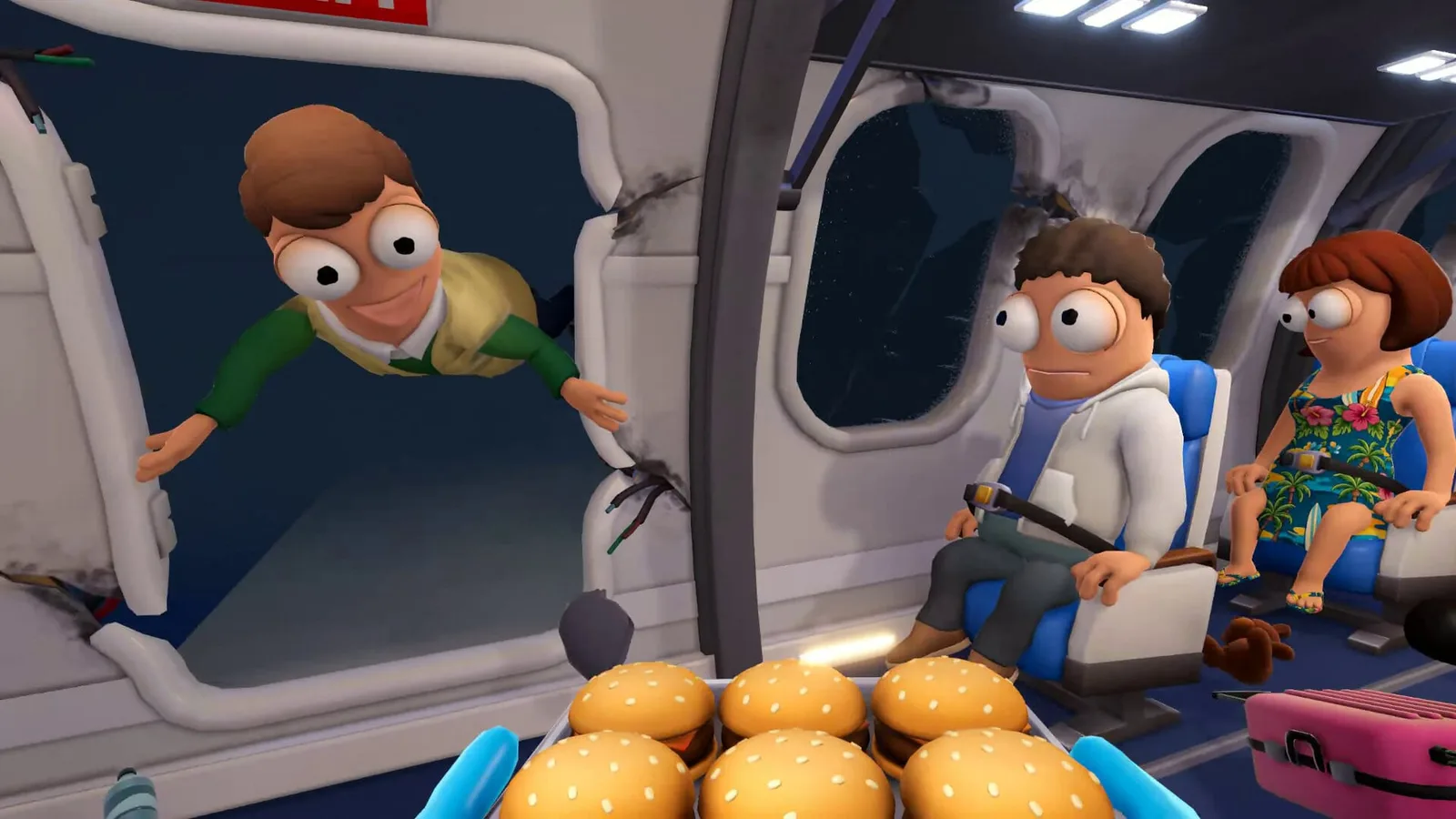
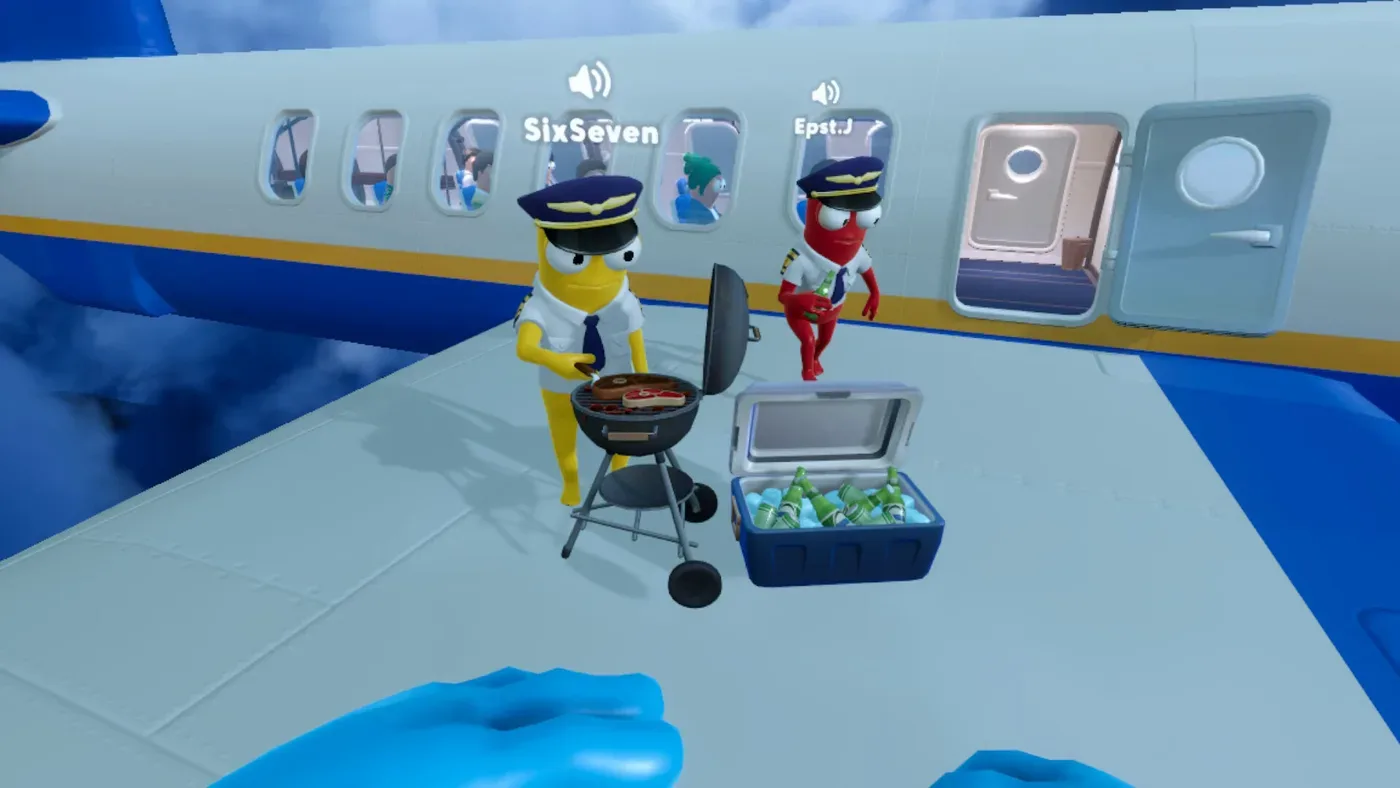
Everyone not flying is cabin crew, and the cabin is where most of Dear Passengers actually happens. Crew serve food and drinks to keep passengers satisfied, calm the frustrated ones and restrain the passengers who refuse to settle, secure cargo in the hold before it becomes a hazard, and repair onboard problems as they appear. Some fixes even send crew outside the aircraft mid-flight — the reveal showed a crew member grilling food out on the wing.
None of these cabin jobs stays tidy for long, because Dear Passengers runs everything on physics. A drink served during smooth air is routine; the same drink served as the pilot dodges a bird is a mess waiting to land on a passenger's lap. The cabin is also where the comedy in Dear Passengers lives, so it rewards players who are happy to improvise — to drop the meal service and go tackle the crocodile, then pick the tray back up once the hold is locked down. On a full crew, the cabin naturally sorts itself into loose specialisms, but everyone has to be ready to abandon their job the instant a bigger fire starts.
Co-op modes
Dear Passengers is listed on Steam with single-player, multiplayer, co-op and online co-op support, so you can crew a flight solo or bring friends in over the internet. The design clearly favors a group — the pilot-and-cabin split only pays off with more than one person — but a solo run is on the table for players who want to learn the routes before inviting a crew. Expect the solo experience to be a different, more deliberate game: one person cannot fly and serve at once, so a lone player leans on autopilot moments and triage rather than the frantic parallel work a full crew thrives on.
How many players?
This is the most common Dear Passengers question, and the honest answer is that FLEXUS has not published a maximum crew size. The game is clearly built around a small crew splitting cockpit and cabin duties, and the co-op friendslop games it is compared to typically land somewhere in the two-to-four range — but any specific number circulating for Dear Passengers is not confirmed by the studio. Treat the exact player cap as unannounced until it appears on the Steam page, and this section will be updated with the figure the moment FLEXUS states it.
Who does what
The cabin crew's four standing jobs in Dear Passengers, each of which can turn into an emergency without warning — and each of which you will drop in a heartbeat when a worse one starts:
- 01
Serve the cabin
Food and drinks keep passengers satisfied — and become projectiles in turbulence.
- 02
Calm or restrain
Settle frustrated passengers, or restrain the ones who will not sit down.
- 03
Secure the cargo
Lock the hold down before a crate — or a crocodile — gets loose.
- 04
Repair and respond
Fix onboard damage and handle emergencies, sometimes outside the plane.
Last updated: 2026-07-15