
Dear Passengers is a physics-based co-op game about crewing a failing airline. The loop is easy to describe and hard to survive: pick a flight, load it, take off, and get passengers and cargo to the ground in roughly one piece. Everything interesting happens in the gap between "roughly" and "one piece," where a calm cabin becomes a scramble in seconds. Press has slotted the game into the "friendslop" wave next to Peak, R.E.P.O., Overcooked and Lethal Company — chaotic co-op you play to make friends laugh — and the gameplay is clearly tuned for exactly that.
The pre-flight manifest
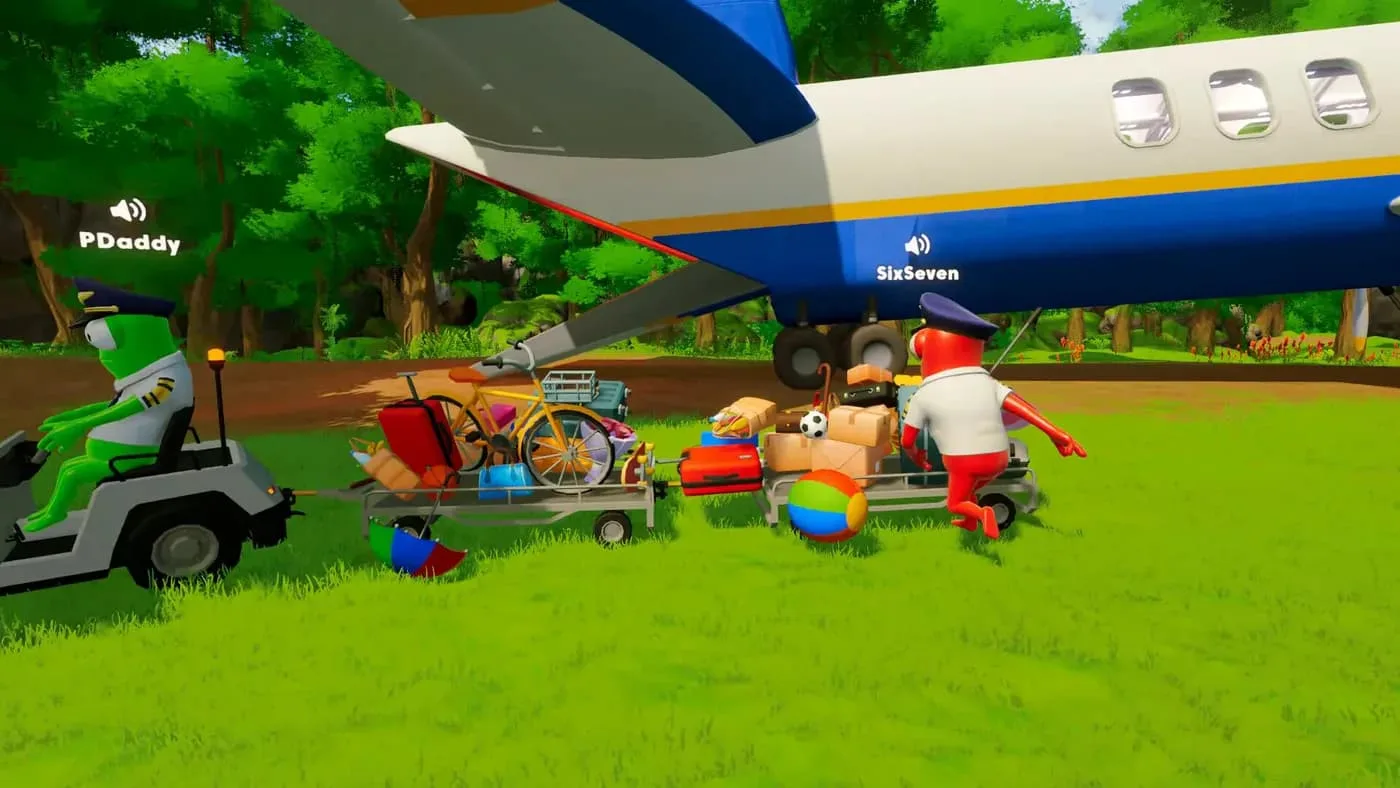
Every run of Dear Passengers starts on the ground, with a choice. Before takeoff the crew selects which passengers and which cargo to carry, and that decision is the real difficulty slider. A light, quiet manifest is survivable for a new crew. A heavy, illegal, high-paying load — the kind that comes with difficult passengers, dangerous cargo, and a flight already tilting toward disaster — pays far better and punishes far harder.
This risk-and-reward selection is what keeps Dear Passengers from feeling like a fixed level list. You are not handed a difficulty; you negotiate it against your own greed. Take the crocodile crate and the nervous flyer for the bigger payout, and you have signed up for the consequences the moment the wheels leave the runway. It also makes Dear Passengers self-balancing for mixed groups: a confident crew can chase the ugliest manifests for bragging rights, while newcomers can take the boring, safe cargo and still finish the same flight.
Ragdoll physics run the show
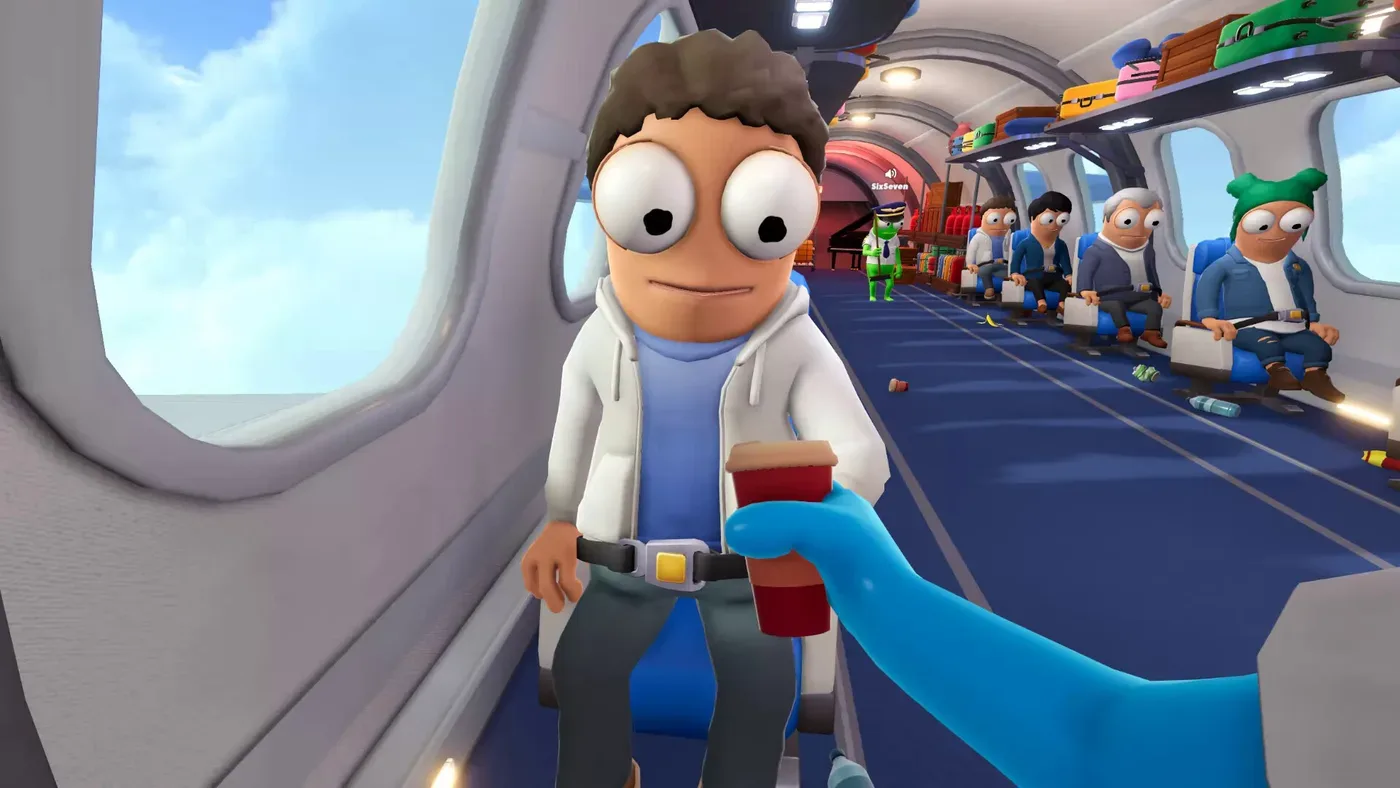
Passengers, crew, luggage and loose objects in Dear Passengers are all driven by ragdoll physics. That single choice is both the comedy engine and the failure engine. A tray of drinks, an unbuckled passenger and a sharp bank are three ordinary inputs that combine into one flying mess, and Dear Passengers rarely lets those inputs stay separate for long.
Because nothing is scripted, the physics is also how Dear Passengers stays readable as slapstick rather than punishment. You can see exactly why the cabin went wrong — someone left a bag loose, someone took the turn too hard — which makes every disaster feel earned and, usually, funny. It is the same object-first comedy that made Overcooked and Moving Out click, pushed into a space that pitches and rolls underneath you. Securing the cabin before trouble hits is less a chore than a bet against the next bump, and a good crew learns to read the plane the way the pilot reads the weather.
Proximity voice chat
Crews in Dear Passengers coordinate over proximity voice chat, so you hear teammates based on where they are on the aircraft. Shouting a warning from the cockpit only reaches the cabin if someone is close enough to catch it. On a plane that is coming apart, that turns communication itself into part of the challenge: the person who needs the warning is often the person furthest from you.
The design rewards crews who split up but stay loud, and it quietly punishes silent efficiency. A ping on a map would let a well-drilled team play in silence; spatial voice does the opposite, forcing the noise and cross-talk that make co-op chaos funny to be in and to watch. In Dear Passengers, a good crew is not just fast — it is a crew that keeps talking while the cabin falls over, relaying "brace" and "grab the croc" down a plane that will not hold still.
Interdependent failure
Work in Dear Passengers is divided across the aircraft, but failure is not. A fire the pilot ignores, cargo nobody secured, or a passenger left unbuckled does not stay a local problem — it cascades into the whole cabin. No station is truly self-contained, which is why the game plays as a single shared emergency rather than four separate jobs happening near each other.
That interdependence is the reason the tension scales with the manifest you chose. The more valuable the flight, the more ways a small mistake in one seat becomes a catastrophe three seats over: a loose crate slides into the aisle, trips a crew member carrying a repair, and now the engine fire nobody reached is spreading while the pilot fights turbulence alone. Dear Passengers is at its best when the crew is one mistake away from all of that at once.
No two flights alike
Weather, the manifest you picked, and live physics combine so that the same route in Dear Passengers rarely plays out the same way twice. Turbulence timing, which passenger panics first, and what breaks first are all variable. FLEXUS frames it as a promise: no two flights should unfold exactly the same, so a route you cleared once can still surprise a confident crew on the next attempt.
For a co-op game built to be replayed with friends, that variance is the point. Dear Passengers is less about memorizing a level and more about handling whatever this particular flight decides to throw at the cabin — which is also what gives it the clip-friendly, "you had to be there" quality the friendslop crowd shares. The story of a flight is different every time because the plane, the weather and four panicking players write it together.
Systems at a glance
The core Dear Passengers loop, boiled down to the four jobs every crew juggles at once — pick the flight, fly it, work the cabin, and keep each of those from taking down the others:
- 01
Pick the manifest
Choose passengers and cargo before takeoff — payout scales with trouble.
- 02
Fly the plane
One pilot holds the heading through weather and hazards.
- 03
Work the cabin
Serve, calm, secure and repair while the physics fights you.
- 04
Contain the chaos
A problem in one section spreads to the whole aircraft.
Last updated: 2026-07-15